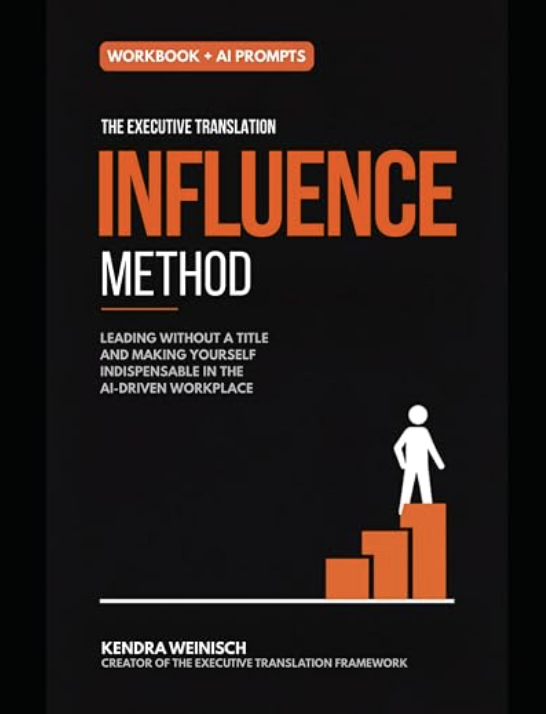
Workbook + AI coaching system
The Executive Translation Influence Method
Leading Without a Title and Making Yourself Indispensable in the AI-Driven Workplace
AI can do the work. It can't do the influencing. This workbook teaches the human skills AI can't replace, and gives you an AI coaching system to practice them: prompts that turn the assistant you already use into a practice partner for your hardest conversations.
On Amazon. Free to read with Kindle Unlimited.
As AI takes over the work, influence is what's left
AI can summarize your meeting, draft your email and organize your information. Every professional now has that. What still separates the people who get promoted is everything AI can't do for you.
What AI does well
- Summarizes the meeting
- Drafts the email
- Organizes the information
What only you can do
- Read the room
- Recognize resistance
- Build trust
- Know when to push, pause or change your approach
Those skills are becoming more valuable, not less. This book is about building them, and about using AI to build them faster.
The AI coaching system
Most leadership books end where the hard part begins. The workbook's "AI + You" sections show you how to use ChatGPT, Claude, Gemini or Copilot for the part AI does well, and where you still have to do the thinking.
"AI is strong at compressing a rambling draft into a headline-first message. It is not good at knowing which specific fact your director cares about, because it doesn't know your director."
The Two-Pass Method
Pass 1: AI
Paste your rough draft into AI. Ask for a headline-first rewrite.
Pass 2: You
Delete one sentence that sounds generic. Replace it with a specific detail only you know about this stakeholder.
Send
Your message now has AI's clarity and your specificity.
From the workbook: an AI + You prompt
Here's a draft email I need to send. Rewrite it using the Executive Translation Headline-First Framework. The ask is [what you need]. The deadline is [when]. The reason is [why it matters]. Then give me a version for a peer and a version for a director. Flag anything in your rewrite that sounds generic enough that I should personalize it further.
Your job after the prompt: find one sentence that sounds like anyone could have written it, and replace it with a sentence only you could write.
The workbook is just as clear about where AI stops: "AI can help you find the right words. It cannot tell you whether you delivered them with conviction. For that, you need a real person and a real room."
For international professionals and global teams
Leading across languages, cultures and time zones
Most influence advice assumes one culture. The workbook doesn't. Its scripts are built on the direct, assertive norms common in many Western workplaces, which can backfire where communication is indirect, hierarchical or consensus-driven. So a full section shows you how to adapt them.
The Global Adaptation Checklist
Run every important message through six questions first:
- How direct should I be?
- What's the hierarchy?
- How is the decision made?
- What's the relationship?
- How is conflict handled?
- Is there a language barrier?
Plus the Cultural Influence Spectrum, to see where you and your stakeholders fall.
The same script, adapted
Direct
"I see it differently. Here's why..."
Adapted for a face-saving environment
"That's a perspective I hadn't fully considered. I see the logic in your position. To build on your thinking, I wonder if we might also consider the implications for [risk area]..."
Direct
"I recommend we take Option A. What do you think?"
Adapted for a hierarchical environment
"I have been analyzing the options and believe Option A has the strongest business case. Before I formalize the recommendation, I would value your perspective on the key trade-offs..."
"The goal is not to write a different message for every person. It is to know which part of your message is non-negotiable (the ask, the deadline, the reason) and which part is adjustable (the tone, the framing, the order)."
Also inside: a workplace story about a US project manager leading a joint initiative abroad, who stopped pushing for decisions in meetings and learned to pre-wire them in private conversations first.
Executive presence in the virtual office
"Influence in person is built through 50 small interactions: a hallway check-in, a quick coffee, a follow-up question after a meeting. In remote work, those moments don't exist. You have to create them deliberately."
The same three signals, new channels
The workbook's three signals of executive presence, certainty, completion and structure, don't change when your team is remote. What changes is how you deliver them: in Slack messages, virtual meetings and weekly updates, deliberately and consistently.
From the workbook: the weekly update
- What I delivered: [specific result]
- What I'm working on: [current priority]
- What I need from you: [specific ask + deadline]
No surprises. Just updates.
Plus scripts for flagging a risk on a video call, finishing your point when you're interrupted, and drawing out a silent virtual meeting.
Not accent. Not grammar. Structure and story. Leading in English as a second language and want one-on-one help? See the Clarity Sprint for international leaders →
The deadline is slipping. You've sent the reminder. Then another. You're accountable for the result, but you don't control the people who have to deliver it.
That's the influence gap. This book is for the professionals who live in it: people expected to lead and deliver results without the title, authority or direct reports that supposedly make leadership easier.
- Engineers
- Product managers
- Project managers
- Business analysts
- Account managers
- Customer success managers
- Executive assistants
- Scrum masters
- Any expert who ends up running the project anyway
What you'll be able to do
- Get people to respond without chasing them
- Make recommendations decision-makers approve
- Push back without damaging relationships
- Raise risks without sounding negative
- Hold people accountable when you don't manage them
- Communicate with executives without over-explaining
- Turn expertise into visible leadership
- Influence decisions you don't have the authority to make
What's inside
An AI coaching system
Prompts that turn ChatGPT, Claude, Gemini or Copilot into a practice partner for difficult conversations and leadership challenges.
10 practical modules
Executive presence, stakeholder management, difficult conversations, strategic communication and leading change.
Word-for-word scripts
For the conversations where professionals freeze, soften the message, or say too much.
Weekly experiments
Small daily habits that build influence through your real work, not theory.
The Executive Translation Phrasebook
Role-specific language for engineers, product managers, analysts and more.
The Influence Ladder Scorecard
See where you are today and where to focus next.
For managers, L&D and team leads
Using the workbook with your team
Your team already has AI tools. Most people use them to draft and summarize, not to get better at the conversations that move work forward. The workbook gives a team a shared method, shared language and a safe way to practice, with the AI assistant your company already allows.
One module a week
Everyone reads the same module and tries its scripts on real work that week.
Practice with AI
Each person rehearses the week's hard conversation with the AI coaching prompts before it counts.
Debrief together
Fifteen minutes in your team meeting: what people tried, what worked, which phrase to keep.
It's built for technical teams, project and product teams, new managers and employee resource groups. If you'd like copies for your team, or a session with Kendra to launch the program, let's talk.
Want the method applied to your own career?
The book teaches the method. If you're a senior expert who keeps hearing "ready next cycle," start with the free 4-minute Scorecard. It shows which of five areas is holding back your next promotion.